
CERC — Environmental Software and Services

- Overview
- Atmospheric dispersion
- Atmospheric chemistry
- Urban air quality
- Regional to local air quality modelling
- Vehicles and roads
- Aviation
- Emissions
- Urban heat island
- Atmospheric boundary layer
- Wind energy
- Hazardous releases
- Inverse dispersion modelling
- Net Zero
- Model evaluation
- Smart cities
- Web platforms
- Older projects
- CERC co-author publications
- CERC software publications
- Presentations
Aviation
Quick links: SNAQ-Heathrow CAEP Local air quality modelling TEAM_Play
CERC researches the impact of aviation on air quality:
- at a global scale, e.g. analysis for ICAO CAEP of the global implications of policy changes such as revisions to the global emissions standards for aircraft engines; and
- at a local scale, such as the SNAQ research project where CERC’s ADMS-Airport model was used for very detailed dispersion modelling of aircraft operations at a single airport, Heathrow, in conjunction with a very detailed monitoring campaign.
Our own software products are fundamental tools in these research activities.
- ADMS-Airport is a comprehensive tool for managing air quality at airports. It is an extension of the ADMS-Urban model, designed to model the concentration of pollutants at airports in rural or complex urban environments.
- EMIT is an emissions inventory tool allowing calculation and manipulation of local air quality and greenhouse gas emissions from airport operation, including main-engine emissions (using ICAO default times-in-mode), GSE, APU, and any surrounding urban or industrial emissions sources.
- The ADMS-Airport Emissions Calculator is a sophisticated tool for calculating aircraft main-engine emissions during landing and take-off. It combines an ECAC Doc 29 performance model with BFFM2 and FAO v3 to calculate emissions of pollutants including PM10, NOx, and NO2.
In a project for the Hong Kong Observatory, CERC have also investigated the influence of complex terrain on the air flow at Hong Kong International Airport: landings are periodically aborted due to significant wind shear which occurs as a result of wind flow over mountain ridges to the south of the airport. FLOWSTAR-Energy is used for this modelling study. Further information can be found here.
We also provide consultancy on aviation and local air quality.
NERC, SNAQ-Heathrow
CERC were partners in the NERC-funded SNAQ-Heathrow project, Sensor Networks for Air Quality at Heathrow Airport. This used a large array of state-of-the-art low-cost sensors for particulates and selected gases, providing a data-set with an unprecedented level of detail. Measurements from the network were used to distinguish airport emissions from long range transport, and then to optimize emissions indices from various airport activities. Combined with detailed emissions and dispersion modelling using the Aircraft Emissions Calculator and ADMS-Airport, the project produced calibrated, high spatial and temporal resolution pollution data-sets demonstrating a powerful validated predictive tool for pollutant concentrations.
UK Department for Transport (DfT), Local Air Quality Modelling Tools for CAEP (ICAO’s Committee on Aviation Environmental Protection)
Under contracts to DfT CERC has contributed to CAEP’s Model and Databases Group for CAEP/7, CAEP/8, CAEP/9, CAEP/10 and CAEP/13. Three examples of the work included under this project are presented below.
1. CAEPport sample problem
In CAEP/8, four Local Air Quality (LAQ) models were evaluated in the Capabilities and Inter Comparison Study, or CAEPport Study. The intent was to provide a side-by-side comparison of the four CAEP-listed LAQ dispersion models, including ADMS-Airport. A ‘mock’ airport was used to exercise the candidate models regarding (1) emissions source characterization and (2) pollutant dispersion modelling according to a common set of input parameters, a shared set of meteorological data, and a uniform array of downwind receptors. The individual model results were compared to understand the range of potential solutions provided to CAEP during the CAEP/8 Work Programme. Significant differences were evident. For CAEP/8 and CAEP/9 these models were used solely for calculating emissions. Their capabilities for concentration calculations may be used in future CAEP rounds.
2. NOx stringency and environmental goals
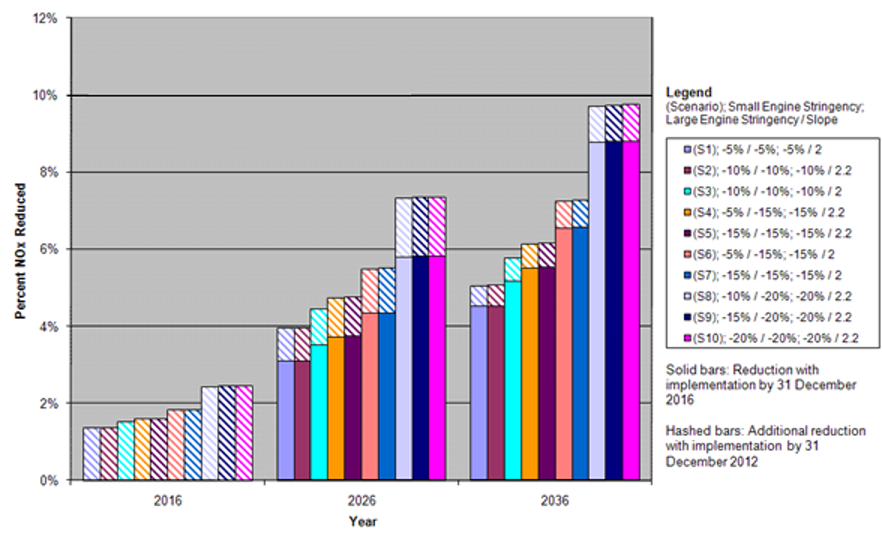
NOx stringency reduction scenario results (all engines). Reduction of NOx emissions below 3000 feet, as percentages relative to no-stringency case. Ten stringency options were assessed, for 2016, 2026 and 2036, using two stringency introduction dates, 31 December 2012 and 31 December 2016.
This study is for the LAQ impacts of ‘NOx stringency’ (a study of the impact of possible changes to aircraft engine emissions limits on NOx) and ‘environmental goals’ (a wider-ranging study of progress towards ICAO’s environmental goals) as part of the policy assessment for CAEP/8. The work involved full calculations of aircraft main-engine emissions with flight performance models including all significant airports worldwide. The assessments helped to formulate the change in NOx emissions limits that was agreed at CAEP/8.
CAEP/9 and CAEP/10 involved little modelling work that was directly focused on LAQ. CERC contributed to relevant reports, for example the revision of the Model Evaluation Paper and the MDG comments on the ICAO Airport Air Quality Manual (ICAO document 9889).
3. LAQ Metric
Since CAEP/12, the LAQ task group has been working on the development of a methodology and metric for assessing pollutant concentrations around airports in trends and stringency analyses. Such a metric would complement existing emissions metrics used in CAEP analysis.
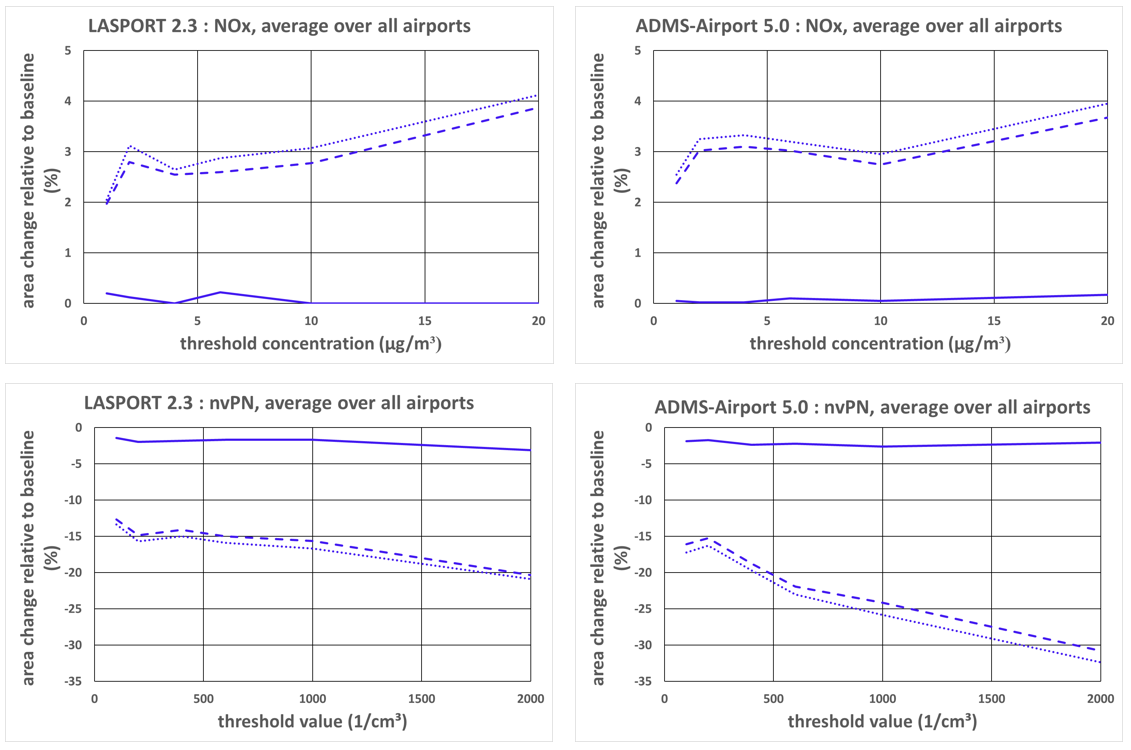
Relative change of the exceedance area, with respect to the baseline, as a function of the applied threshold value for three stringency options, averaged over four airports. Results for LASPORT (left) and ADMS-Airport (right) for concentrations of NOx (top) and non-volatile particle number (bottom).
The feasibility and robustness of an LAQ Metric, based on the calculation of exceedance areas at individual airports, was demonstrated in CAEP/13. This comprised a comparison of results from ADMS Airport and another CAEP-listed dispersion model, for baseline and stringency scenarios across a set of four airports. The comparison confirmed that, despite the dispersion models giving different concentration threshold exceedance areas for the same scenarios, the models yield the same rankings of stringency options and these rankings are insensitive to the threshold concentration.
For the practical application of an LAQ Metric for CAEP trends and stringency analyses, a proof of concept and initial testing of a Segmented Footprint Approach for dispersion calculations was carried out in CAEP/13. This approach will enable rapid screening of future aircraft emission scenarios across many airports, using a common tool and bespoke output from CAEP dispersion models.
CERC works on these studies with the other members of the MDG sub group for Local Air Quality (LAQ) modelling. The other members include US FAA, ENVISA (sponsored by EUROCONTROL), and Janicke Consulting (sponsored by FOCA and BMVBS).
CERC’s participation in ICAO CAEP was sponsored by UK DfT.
Learn more
- ADMS-Airport: Model Inter-Comparisons and Model Validation A paper presented by CERC at HARMO 12, which describes the CAEPport inter-comparisons
- ICAO CAEP website
European Commission, TEAM_Play
CERC were partners in the EC FP7 research project TEAM_Play (Tool Suite for Environmental and Economic Aviation Modelling for Policy Analysis). TEAM_Play has set up an effective and efficiently working Tool Suite to provide powerful tools for the performance of adequate policy assessment studies within ICAO-CAEP and on European, national and local levels. This included a number of studies of hypothetical future changes to aircraft engines such as the introduction of a CO2 emission standard and the introduction of ‘open rotor’ engines.
CERC are one of the four partners within TEAM_Play who operated Local Air Quality models. ADMS-Airport and its Emissions Calculator were used in a variety of demonstration problems to prove their capability for carrying out assessments of the impact of aviation on Local Air Quality, through dispersion modelling and detailed performance-based modelling of aircraft main-engine emissions.