
CERC — Environmental Software and Services

CERC news


< Previous12345678910111213141516171819Next >
10 Nov 2026CERC announces transition to employee ownership
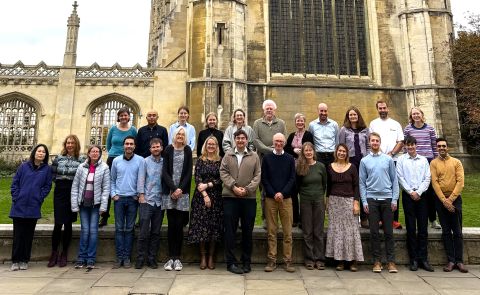
CERC is proud to announce the establishment of an Employee Ownership Trust (EOT) to secure the long-term future of the company for its clients, partners and employees.
David Carruthers and Tim Newton (who co-founded CERC alongside Julian Hunt, Rex Britter and Ken Pye) made the decision to transition to employee ownership in order to place the organisation's future in the hands of those who have contributed to its success. David Carruthers will remain as Managing Director for an interim period.
Between them, new Directors Sarah Strickland, Jonathan Handley, Martin Seaton, Amy Stidworthy and Laura Osborne have well over 100 years' worth of experience at CERC and are committed to maintaining the unique blend of scientific leadership, research expertise and commercial independence that has defined the company over the past 40 years.
Through the EOT structure, the company's employees will become the principal beneficiaries of the business, while driving its continued success.
2 Nov 2026Air quality modelling to support Thurrock’s Local Plan
Thurrock sits on the River Thames at the maritime gateway to London. CERC were commissioned to carry out air quality modelling to support Thurrock's Local Plan, which proposes residential developments, new ports, and modern logistics hubs.
In particular, road traffic emissions are expected to change due to proposed residential developments and increased freight activity linking the expanded ports with the rest of Britain.
Thurrock Council provided three transport models:
- A base year traffic model (year 2023) to verify the model set up and investigate current air pollution levels.
- A future reference case traffic model (year 2044), which did not include Local Plan developments.
- A future local plan traffic model (year 2044), which accounted for proposed Local Plan developments across Thurrock.
We modelled all three scenarios using our dispersion modelling software, ADMS-Urban. We collated emissions from non-road sources using the NAEI and adjusted them to the future year through comparison with concentrations from Defra background maps. This allowed us to quantify future emissions, broken down by location, source type, and pollutant.
By 2044, concentrations of NO2 are predicted to decrease significantly compared to current levels, while particulate (PM10 and PM2.5) concentrations are expected to stay broadly similar. Therefore, our attention was mainly drawn towards comparing the future Local Plan scenario with the future Reference Case scenario.
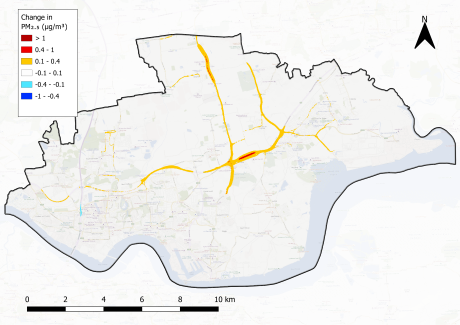
Results showed that NO2 and particulate concentrations increased slightly with the Local Plan compared to the Reference Case. Increases in air pollution were localised to the main industrial hubs and along the strategic road network (see image), with much less impact on residential areas.
Compared to air quality objectives, the NO2 concentrations exceeded the objective at only one major motorway junction in both the reference case and with the Local Plan, with no long-term human exposure. The PM10 and PM2.5 standards were met across the borough.
CERC's work shows that the growth and development associated with Thurrock's Local Plan can be balanced with impacts on air quality. The Local Plan will not result in any significant adverse air quality impacts for the residents of Thurrock.
The report for Thurrock's Local Plan is published on the EssexAir website.
20 Oct 2026New research on the air quality impact of Low Traffic Neighbourhoods in London
Between March and September 2020, 72 Low Traffic Neighbourhoods (LTNs) were introduced in London. There is growing evidence that LTNs provide a range of benefits for residents within the scheme area. However, there are also concerns about potential negative impacts on residents outside the LTN.
The potential benefits and harms of these LTNs were investigated through the Low Traffic Neighbourhoods in London Research Study, funded by the National Institute for Health Research (NHIR135020).
As part of this study, CERC worked with the University of Westminster, the University of Cambridge, Imperial College and London School of Hygiene and Tropical Medicine to publish a paper which quantifies the air quality impacts of five London LTNs.
This is one of the first studies to assess the impacts of multiple LTNs over the same period within the same city, and to use Google API data of live traffic conditions to accurately represent traffic speeds and congestion before and after the implementation of the LTN.
ADMS-Urban was used to model the concentrations of harmful pollutants NO2, PM10 and PM2.5 before and after the implementation of the LTNs. Emissions from roads inside the LTNs and along boundary roads were calculated from traffic flow, speed and congestion data. The modelling considered three periods: before the LTN, and the first and second years following the LTN implementation. Year one data captured the immediate shift in road traffic due to the LTNs, while year two represents longer-term changes in travel behaviour.
The modelled concentrations were then used to calculate health outcomes at Lower Layer Super Output Area (LSOA) level.
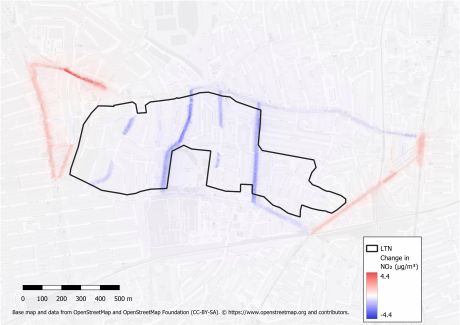
The study found that annual average NO2 and PM10 concentrations decreased slightly within the LTNs. Along the boundary roads, the impacts were mixed, but there was no overall increase in pollutant concentrations. The health modelling estimated that the LTNs lead to a modest reduction in the number of deaths and the number of cases of childhood asthma across the LTNs and their surrounding areas, but the size of these effects was small.

16 Oct 2026CERC second in Cycle September UK challenge
Last month, CERC took part in the Cycle September challenge, organised by Love to Ride.
During the month of September, CERC staff cycled a combined distance of 1,487 miles (50 miles a day!), the equivalent of taking 350 kg of CO2 off our roads.
Each one of our active riders cycled an average of 3 miles each day, showing how small, individual efforts can accumulate across a community. We achieved two-thirds participation, supported by our Cambridge location with its safe, scenic, and well-used cycle routes.
A notable achievement for us was that, out of more than 200 organisations in the SME 20–49 staff category, CERC finished second overall on the UK leaderboard. One of our consultants even won a pair of socks!
The Cycle September challenge is open to companies of all sizes. 224 workplaces across the Cambridge and Peterborough area rose to the occasion. Together, we racked up 150,000 miles and saved 37 tons of CO2 from the exhaust. Congratulations to all who took part! By taking cars off the roads, we are reducing traffic and therefore air pollution, making our towns healthier places to live.
Cycle September comes around once a year. Mark it in your calendar for next year and encourage your workplace to make a difference.
25 Sep 2026Helping users choose CERC software for air quality assessments, including modelling under EU Ambient Air Quality Directive
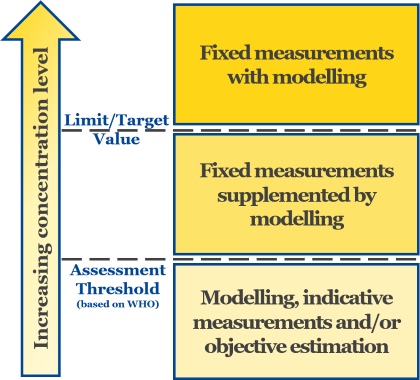
A new online resource has been added to our website to help users identify the most suitable software for their specific air quality assessment requirements. This provides a practical starting point for both new and experienced users by presenting common assessment scenarios alongside the corresponding modelling solutions. It also includes a high-level overview of the most common assessment applications that can be undertaken using the ADMS suite and other CERC software solutions, complementing the detailed information about each software package already available on our Environmental software page.
For modellers within the EU, the resource is particularly relevant in the context of the latest European Union (EU) Ambient Air Quality Directive (AAQD) 2024/2881, which places a strong emphasis on the use of air quality modelling as a key component of compliance assessment, source apportionment studies, and the development of air quality plans. It highlights the capabilities of the Multi-Model Air Quality System (MAQS), one of CERC's solutions for addressing these modelling requirements. By coupling the street-scale ADMS-Urban model with regional-scale air quality models, MAQS enables the consistent assessment of pollutant concentrations across a wide range of spatial scales, from local hotspots to national and transboundary levels. This integrated approach aligns closely with the requirements of the Directive, making MAQS well suited to supporting air quality assessment and management within the EU.
You can also follow CERC news on Facebook, X, LinkedIn and by RSS.
< Previous12345678910111213141516171819Next >